Ignorance Posing As Intelligence


The Invisible Everywhere: the story of how modern science shattered my atheism & opened my eyes to the existence of God.
👉 WATCH NOW!👈
Please consider becoming a Paid Subscriber. By doing so you’ll support my efforts to speak truth with love to a world sorely in need of both.
Thank you and God bless you.
Apparent Intelligence
For decades scientists dismissed much of the human genome as superfluous and unimportant. They called it “junk DNA,” a phrase popularized in 1972 by Japanese-American geneticist Susumu Ohno.
This scientific consensus arose from the observation that only a tiny fraction of our total DNA directs the production of proteins that make life possible - and that give each of us our unique traits. Between those all-important protein-coding DNA elements are vast stretches of genomic material that appeared to have no purpose.
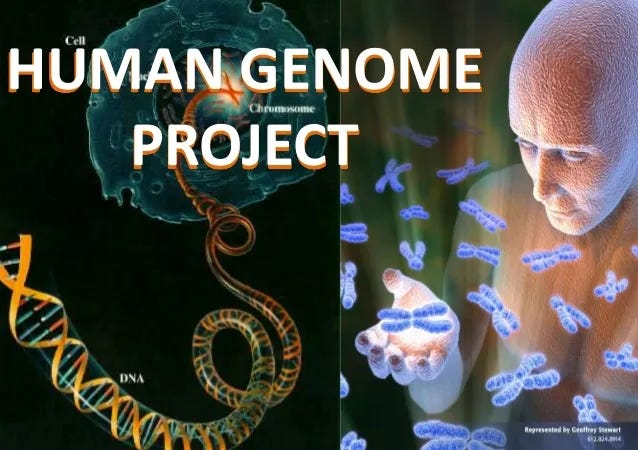
Starting in 2001 this scientific consensus appeared to be roundly affirmed by the Human Genome Project, which produced successive drafts and analyses of human DNA. In the end the project revealed that we possess only about 20,000 protein-coding genes, accounting for about one percent of our entire genome. The remaining ninety-nine percent was widely portrayed - especially in popular accounts - as “junk DNA,” largely useless biological clutter.
Actual Ignorance
With the increasing sophistication of genome-mapping technology, however, the dismissive Junk DNA consensus began to fall apart.
Much to their surprise, scientists discovered that, in fact, many of those supposedly useless stretches of noncoding DNA act like elaborate control centers. These Svengali-like stretches help dictate which of our 20,000 genes are switched on or off, in which of our many cells, at what stage of our development, and under what circumstances.
Scientists also discovered that other allegedly useless regions produce “functional RNA molecules” that help manufacture proteins, process genetic messages, and regulate cellular activity. Still others contribute to the organization, three-dimensional structure, stability, and protection of chromosomes - the tightly packaged DNA structures that contain our 20,000 genes.
Whew!
In 2012 the international ENCODE project publicly reported that the human genome is far more biochemically active than the simplistic Junk DNA consensus envisioned. Today, molecular geneticists continue discovering and debating the exact purposes of our genome’s vast, noncoding regions, but science’s once ignorant view of DNA has been permanently undermined.
Scientific Arrogance
Science’s monumental about-face offers us an important lesson in scientific humility. A lesson too many of today’s scientists - and science worshippers - seem not to have learned.
The scientific method is arguably the most brilliant way we have of learning about the natural world. But science is notoriously fallible. Its conclusions are always limited by the evidence available, the instruments being used, the assumptions guiding the investigation, and the questions researchers have thought - and not thought - to ask.
What appears useless today may prove indispensable tomorrow. What seems settled in one generation may be revised, refined, or overturned in the next.
Scientific humility at its best says, “This is what the evidence presently suggests - but we may not yet possess the whole picture.” That attitude leaves room for surprise, correction, and discovery. Indeed, nearly every major scientific revolution began when someone dared to question what the experts of the day regarded as obvious.
Sadly, such humility is rarer than it should be because scientists are human beings, susceptible to pride, ambition, groupthink, professional rivalry, and the desire to be proved right. Careers, reputations, grants, publications, and institutional prestige often hinge on being right; so admitting uncertainty can often feel like committing professional suicide.
What’s more, in today’s era of mass communication bold claims attract big headlines. “We do not yet know …” is usually less exciting and attention-getting than “Science has proved ….” As a result, tentative scientific findings are sometimes presented to the public as final verdicts and dissenting opinions are seen as threatening.