
ETs: Where Is Everyone??
We Are Not Alone

Glorious Day My Precious Fellow Traveler -
I love writing these posts. But they require a great deal of time and toil, because God demands and deserves my very best effort.
My prayer for 2026 is that I’ll be able to stop doing other, less fulfilling things and instead support this burgeoning Substack ministry fulltime. That’ll be possible only with the support of Paid Subscribers. But I’m surrendering the entire matter to God.
From the bottom of my heart, thank you to my Paid Subscribers from 48 states and 35 nations for supporting my ministry, which is committed to speaking truth with love … to a world sorely in need of both.
To God alone be the glory!
Amen.
Life In the Universe
Any serious discussion about ETs must begin with this astonishing, 20th-century scientific discovery: The universe is genetically predisposed for life.
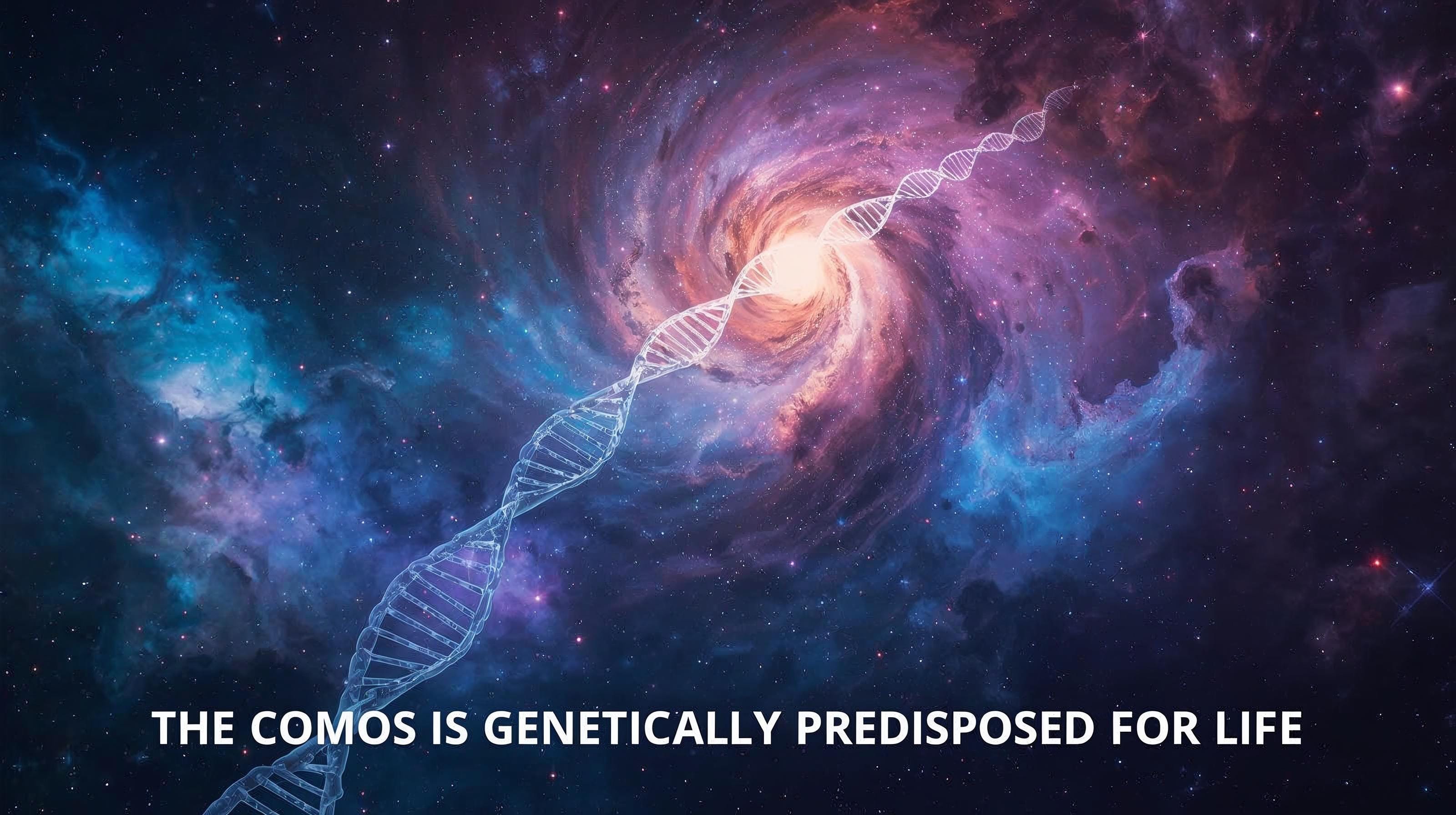
That’s right. Like you and me, the cosmos has something like a genome comprised of many “genes,” or what we scientists call natural constants. We’re not sure exactly how many there are, but the number is probably somewhere between 20 and 30.
Each cosmic gene determines a fundamental trait of the physical universe, such as: (A) the strength of gravity, (B) the mass of the electron, (C) the number of the universe’s spatial dimensions, (D) the speed of light, (E) the expansion rate of the universe, and (F) the destructive power of the nuclear force, just to name a few.
During the late 20th century, scientists used powerful telescopes and other, clever instruments to decode many of these all-important genes, and guess what? Every single one of them, without exception, has precisely the value needed for life to exist. Not just life on Earth, but life throughout the universe.
If even one of the cosmic genes were off by just a tiny, tiny bit the universe as we know it wouldn’t exist. Not only would it look completely different - no stars, no planets, no atoms - it would be a lifeless, cosmic-sized ghost town. In particular there would be no us - no human beings - wondering if we were alone.
At the close of the 20th century, therefore - knowing that the universe is tailormade for life - the ETOI (ET Optimism Index) was sky-high. That is, we had every right to believe we were not alone in the cosmos.
Fermi’s Paradox
In truth, the ETOI was already quite high as early as the 1930s, well before we knew about the universe’s remarkable genome. That’s because most people reasoned thusly: The universe is filled with so many galaxies, so many stars, so many planets, there’s got to be life out there somewhere. There’s got to be! It’s only a matter of time and effort before we find it.
By the 1950s, however, some people began expressing skepticism. One of them was physicist and Nobel laureate Enrico Fermi, famous for having built the world’s first nuclear reactor.
At lunch with friends one day, Fermi cited a calculation he’d done showing that the Milky Way galaxy alone - our home galaxy - should be teeming with ETs. So, then, he asked: Why haven’t they long-since made overt, unambiguous contact with us? In other words, “Where is Everyone??”

The Search Begins
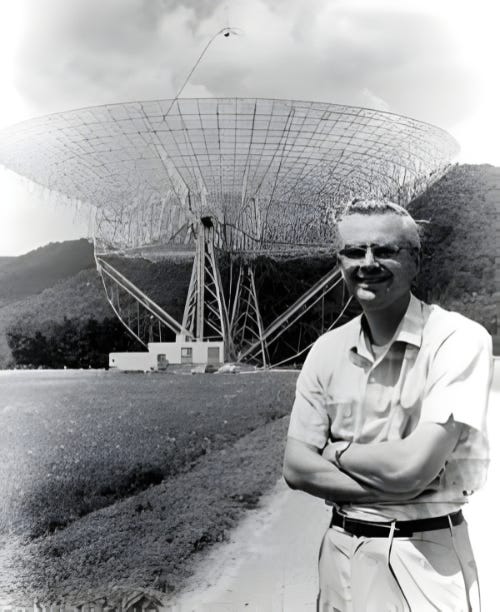
As a graduate student at Cornell I had the great fortune of being taught by Professors Frank Drake and Carl Sagan, the legendary founders of SETI (Search for Extraterrestrial Intelligence). In 1960 Drake became the first scientist to run an experiment specifically aimed at looking for ETs. He named his search “Project Ozma,” after the fictional queen of Oz.
For four months - from April to July - Drake aimed a giant radio telescope (effectively, a gigantic ear) at two stars 64 trillion miles away: Tau Ceti and Epsilon Eridani. During that time, there was an exciting false alarm - probably caused by Earth-bound radar -but otherwise, sad to say, Drake heard nothing but static.
Since then, scientists and amateurs worldwide have conducted countless other rigorous SETI experiments, many of which I’ve covered for major news outlets. But, alas, all the searches have detected the same thing: crickets.
In a 2015 Op Ed for Fox News, I described a landmark SETI experiment run by Pennsylvania State University astronomers. Using the Wide-field Infrared Survey Explorer - an eagle-eyed NASA infrared space telescope - they scrutinized 100,000 galaxies for signs of life. What did they find? Nothing. Nada. Nichts.
More recently, vast, well-funded searches using the powerful Hubble, James Webb, and Euclid space telescopes have likewise found nothing - not a single, solitary ET.
Along the way, yes, SETI experiments have come across some tantalizing, headline-making bread crumbs. For example: (A) exoplanets with potentially habitable atmospheres; (B) organic molecules in deep space; (C) possible technosignatures (e.g., electromagnetic signals); and (D) potential biosignatures (e.g., metabolic chemicals). But they haven’t found one ET, nor even a primitive living microorganism, nor anything coming even close to resembling actual life.
Nevertheless, the bread crumbs - plus constant hype from parties with a vested interest in SETI - have been more than enough to keep alive the public’s enthusiastic belief in the existence of ETs. Today’s rage reminds me of the 1950s - the dawn of the modern Space Age - when it seems everyone was looking up at the night sky hoping to spot - or claiming to spot - a flying saucer.
It was a time when Hollywood produced some of cinema’s most memorable (and, in many cases, cheesiest) outer-space movies. To this day, they include some of my all-time favorites: Invaders From Mars (1953), The Thing From Another World (1951), Destination Moon (1950), and The Day the Earth Stood Still (1951).

Between the 1950s and now, there have been lots of UAP (unidentified aerial phenomena) sightings, UAP government hearings, independent UAP investigations, UAP books, movies, speeches, and merchandise. And, yet, here we are with still no slam-dunk, conclusive evidence that life exists anywhere other than the earth.
Yes, I know it’s a hard pill for many people (including me) to swallow. But it’s a fact: We still have not captured any ET; not captured any ET spacecraft; not received any ET radio transmission; not secured any authenticated ET artifact - not so much as a hanky - that proves beyond a reasonable doubt that we have been visited, or are being visited, by physical creatures from another world.
Believe me, I wish it weren’t so. When I was a boy madly in love with science, I wished oh-so-hard that I could lay eyes on an ET. But now, as a sober-minded scientist - knowing what science has failed to discover, despite decades of trying - I can’t and won’t give into wishful thinking.
Spiritual Intelligence
If I were still an atheist, this would be the end of our discussion. There’d be little more that I could add to alter the (at least, for-now) compelling conclusion that we are, indeed, alone in the universe.
But I’m no longer an atheist, so our discussion is far from over. In fact, it’s just beginning to get interesting.
Many years ago, when I was teaching physics at Harvard - and, I might add, well along on my Hermann Hesse-like spiritual journey, which I describe in Believing Is Seeing -I coined the term “Spiritual Intelligence” (SQ) to describe a hypercognitive ability unique to humans. Among other things, SQ enables us to perceive, albeit imperfectly, the existence of realities that are both non-physical and what I call translogical.
In light of that concept - and the compelling scientific and Biblical evidence that supports it - it’s now reasonable for us to ask a simple but profound question: “Is it possible some of the UAP sightings reported over the centuries are of spiritual beings?”
Before you laugh off the question, consider two extraordinary phenomena modern science has discovered.