
The Call of the Unknown
The Real Reason We Travel Into Space

Glorious Day My Precious Fellow Traveler -
According to today’s theory of evolution - which I often call today’s theology of evolution, owing to its resemblance to an ideologically driven religion - we’re purely physical creatures no different than any other animal. This appraisal of our species, Homo sapiens sapiens, is of course entirely consistent with science’s overall, naturalistic interpretation of reality.
According to this secular worldview, there are just two principal goals in life: (A) survive and (B) procreate. That’s it. Fight for your life like a cornered animal, and have as many babies as you can.
Evolutionary biologist and well-known Atheist Richard Dawkins attempts to explain this thesis in his well-written, bestselling book The Selfish Gene. In it he claims that individual life forms - you and I - are merely expendable vehicles by which selfish genes perpetuate themselves.

To be sure, we are a competitive species; and a highly sexed one to boot. But does modern evolutionary biology’s meager portrayal of life sound entirely credible to you? Is your life meaningful only insofar as your genes successfully survive to live and fight another day?
My answer is, no. I regard that view of human life as base and simpleminded. It doesn’t even come close to accounting for the rich, complex, adventurous, deeply mysterious and paradoxical history of our kind.
The Space Age
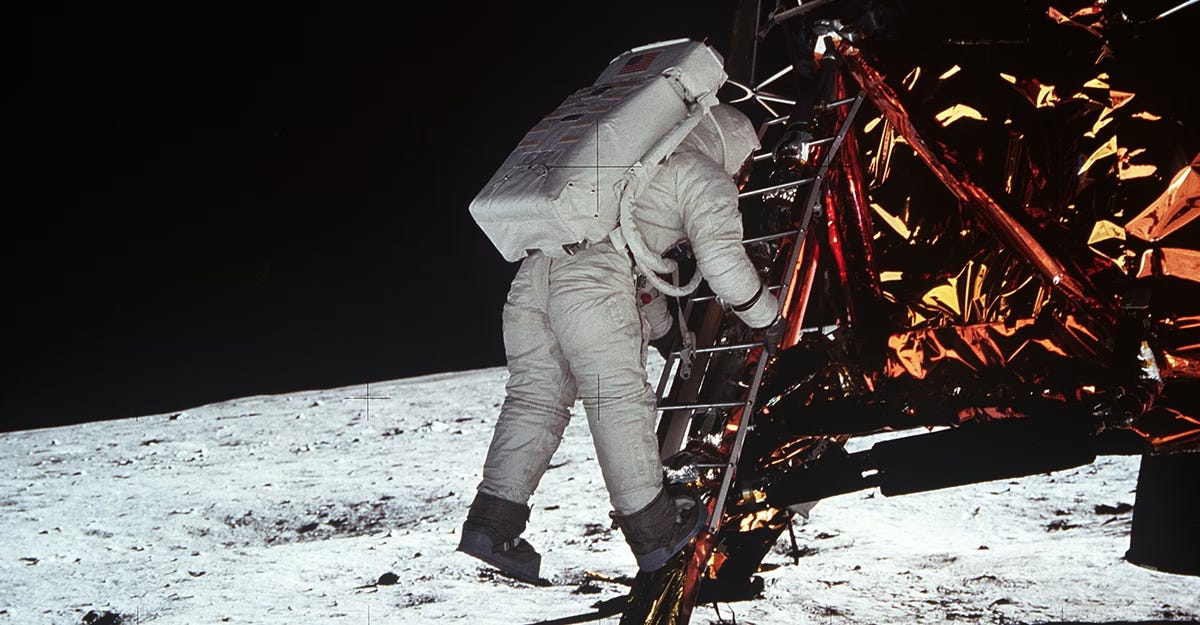
I’m a child of the original space race. As I write these words I can see myself sitting on the floor of our den, together with all my neighborhood friends, watching the smudgy, black-and-white TV images of Neil Armstrong stepping off the ladder of the Lunar Excursion Module, intoning, “That’s one small step for man, one giant leap for Mankind.”
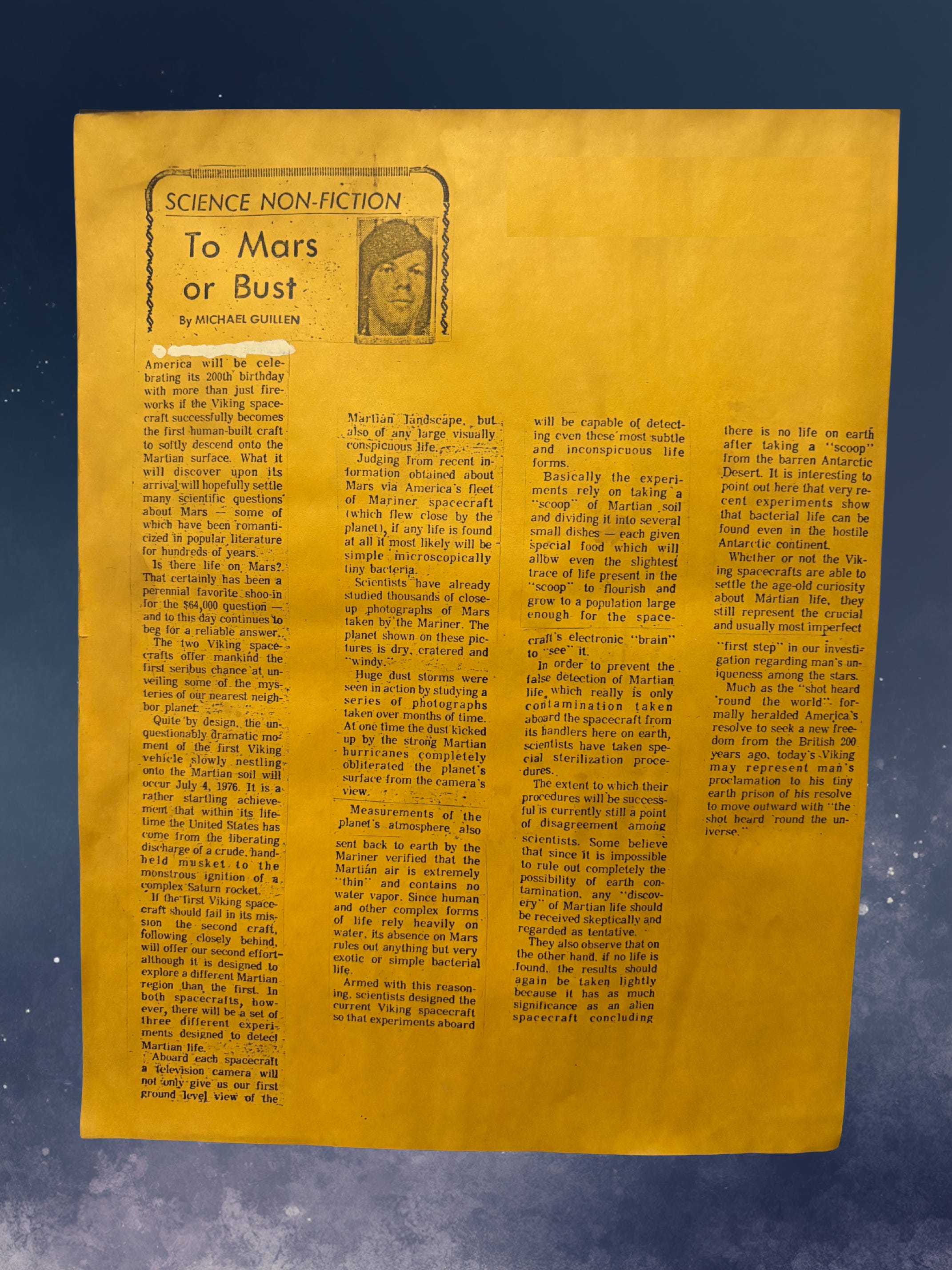
I can also see myself as a nerdy youngster typing up his very first weekly newspaper column, which appeared in scores of PennySavers throughout Southern California. I titled the article, "To Mars or Bust.”
In it, I wrote this:
“Is there life on Mars? That certainly has been a perennial shoo-in for the $64,000 question - and to this day continues to beg for a reliable answer.”
Back then, critics of the U. S. space program wondered angrily how anyone could possibly justify spending billions of dollars to send astronauts to other worlds when people on Earth were starving to death. In 1964 Israeli-American sociologist Amitai Etzioni said this in his book The Moon-Doggle:
“Above all, the space race is used as an escape, by focusing on the moon we delay facing ourselves, as Americans and as citizens of the earth.”
Today, when we’re in the midst of an exciting, new iteration of manned space exploration - this time funded primarily by wealthy entrepreneurs such as Elon Musk, Jeff Bezos, and Richard Branson - the critics are at it again, with the very same complaint. In a recent editorial in The Guardian, U. S. Senator Bernie Sanders wrote this:
“At a time when over half of the people in this country live paycheck to paycheck, when more than 70 million are uninsured or underinsured and when some 600,000 Americans are homeless, should we really be providing a multibillion-dollar taxpayer bailout for Bezos to fuel his space hobby? I don’t think so.”
There’s a part of me that gets Senator Sanders’ dissent, gets his compassion for those in great need. How could I feel otherwise and still call myself a Christian?
But there’s another, larger part of me that recognizes the gross inaccuracy of Senator Sander’s position. It relies on the same fallacious reasoning peddled by all the critics of space exploration, namely: Exploring space is a waste of time and money; if only we gave it up, we’d be able to solve the world’s many social problems.
In fact, exploring space has not been a waste of time and money, nor has it worked against social advancement - far from it. The technologies that scientists have created to explore the heavens have, in fact, made life on Earth significantly safer, healthier, and more tolerable.
From better cancer-screening devices and 3D-printed, affordable housing units to heartbeat detectors used to locate missing persons in search-and-rescue operations and anti-gravity treadmills used by patients going through physical therapy - the fruits of our decades of space exploration have significantly improved the lives of nearly everyone on planet Earth.
That said, however, these payoffs aren’t the main reason we explore space.
The Call of the Unknown
Discovering the real reason we explore space begins by recognizing one glaring difference between us and all other animals.