
THE SHROUD OF TURIN
Masterpiece, Miracle, or Mirror?

Whatever you think about the Shroud of Turin - the alleged burial cloth of Jesus of Nazareth - it’s one of the most intensely studied artifacts on the planet and, to this day, is still the subject of an impassioned debate.
WHAT WE KNOW
APPEARANCE
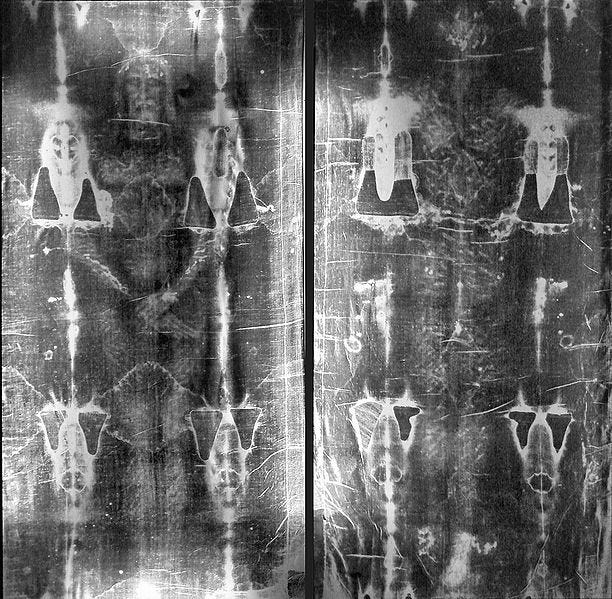
The Shroud of Turin is 14.3 feet long by 3.6 feet wide and made of linen. On it is the image of a man with the following wounds, as ascertained by numerous medical examiners, pathologists, and scientists:
Backside: The man’s back, buttocks, and legs have more than 100 dumbbell-shaped contusions, consistent with the strike pattern of a Roman flagrum, a short whip with many leather thongs, each tipped with two small lead balls or pieces of bone designed to tear through skin and muscle.
Face: The man’s face shows significant swelling on the right side, particularly around the eye and cheekbone. The nose also appears misaligned, indicating torn cartilage or a fracture.
Head: There are dozens of deep puncture wounds covering the entire top and back of the man’s scalp, consistent with a dense cap or helmet of thorns being forced onto the man’s head.
Shoulders & Knees: There are deep, heavy abrasions across both of the man’s shoulder blades overlaying the whip marks, consistent with the friction of carrying a heavy, rough wooden crossbeam (patibulum). Additionally, both knees are severely bruised and contain microscopic traces of dirt and limestone, indicating violent, unprotected falls onto hard ground.
Wrists & Hands: The man’s wrists (specifically, the “Space of Destot”) have puncture wounds. Also, the thumbs are not visible. This is consistent with nails being driven through the wrist, which damages the median nerves, which causes the thumbs to instinctively lock inward across the palm.
Arms: The angle of the blood trailing down the man’s forearms is consistent with the gravitational physics of a crucified body.
Feet: The image indicates the man’s feet were crossed, with the left foot placed over the right and transfixed to an upright post with a single, large nail driven through both arches.
Torso: On the right side of the man’s chest, between the fifth and sixth ribs, there is an elliptical wound consistent with the dimensions of a Roman spear (lancea).
PROVENANCE
If the Shroud is genuine then its journey began circa 33 AD inside a burial cave beyond the walls of ancient Jerusalem.
The first report of its existence, however, dates back to just ca 1353-1357. It was owned by Geoffroi de Charny, a French knight who displayed the cloth in a church he built in Lirey, France.
In 1453 Charny’s granddaughter Marguerite gave the Shroud to Duke Louis I of the powerful House of Savoy, Italy’s future royal family, in exchange for some expensive real estate and a handsome pension.
In 1532, the Shroud barely survived a fire in the Sainte-Chapelle in Chambéry, France, the House of Savoy’s capital city. A drop of molten silver from its protective casket burned completely through the folded cloth, and the water used to extinguish the flames left distinct, symmetrical water stains.
In 1578, the House of Savoy moved the Shroud to their new capital city, Turin, Italy, where it was placed in the Cathedral of St. John the Baptist. It remains there today in a climate-controlled, bulletproof case.
IMAGE
The image on the Shroud penetrates only the fabric’s top two or three microfibers. It does not soak through.
In 1978, the Shroud of Turin Research Project (STURP) - a team of physicists, chemists, and engineers from institutions such as Los Alamos and NASA - determined the image was not brushed on nor created with any paints, dyes, or stains.
In 1898 Secondo Pia, an Italian lawyer and photographer, discovered that the Shroud’s image is a photographic negative. The negative of the negative revealed a stunningly detailed, positive image of the Shroud man - more evidence the Shroud image is no mere painting.
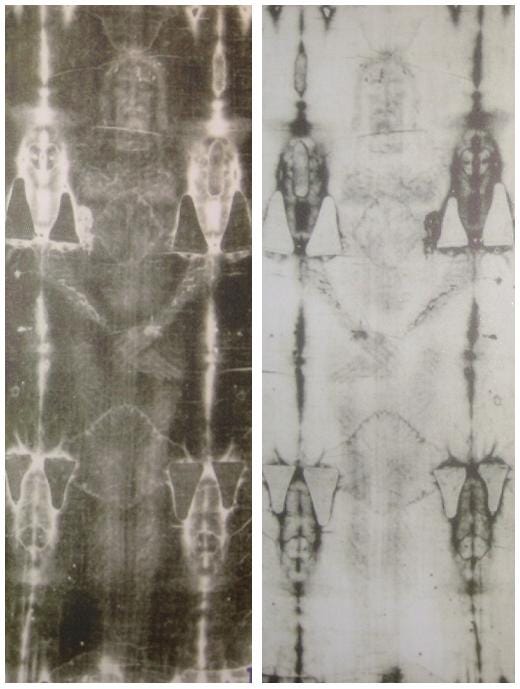
Using a VP-8 Image Analyzer - a tool NASA has used to map lunar elevations - scientists discovered that the intensity of the image correlates with the distance the cloth would’ve been from a three-dimensional human body - still more evidence the Shroud image is no mere painting.
No one has been able to use medieval techniques or modern laser technology to reproduce all the Shroud’s unique properties: the image’s superficiality, lack of pigment, photonegative quality, and 3D spatial encoding.