
The Truth: Galileo vs the Church

“Amazing film.
You cannot stay an unbeliever after watching it. 🙏”
Bijou K.
The Invisible Everywhere: Believing Is Seeing presents the modern scientific evidence that shattered my lifelong atheism and opened my eyes to the existence of God.
👉 Get Your “Ultimate Expedition” Ticket Now & Start Watching!👈

Mrs. G and I are not part of a large organization; its just the two of us working hard to serve the God we love. So please consider becoming a Paid or Founding Subscriber. By doing so you’ll not just benefit from these weekly letters, you’ll actually support them and our efforts to speak truth with love to a world sorely in need of both.
Thank you and God bless you.
A reporter recently asked me:
“Many people see science and religion as opposing forces.
Why do you believe that divide persists culturally?”
In this letter I will expand on the brief answer I gave her.
The Galileo Myth
Galileo Galilei’s legendary confrontation with the 16th-century Catholic Church is one of the most famous stories in Western civilization. Repeatedly invoked in op-eds, college lectures, Twitter arguments, and conversations at dinner tables, the conflict is usually portrayed as a straightforward morality play: a brave man of science silenced by ignorant religious authority.
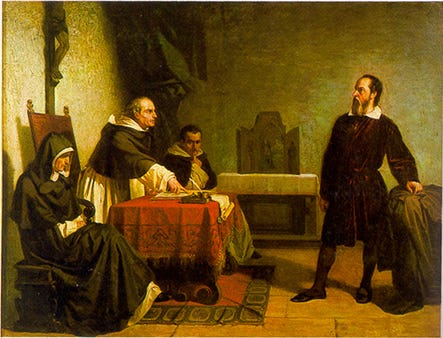
Because of that mischaracterization, the big takeaway for too many Christians is that, “science is the enemy of faith.” And so they must guard themselves against science’s secular inquiries of the natural world.
For too many atheists, the big takeaway is exactly the opposite, yet equally flawed: “religion is the enemy of reason.” They use their misunderstanding of the Galileo affair to bludgeon Christians as backward, dogmatic, and hostile to facts.
Both conclusions are completely misguided.
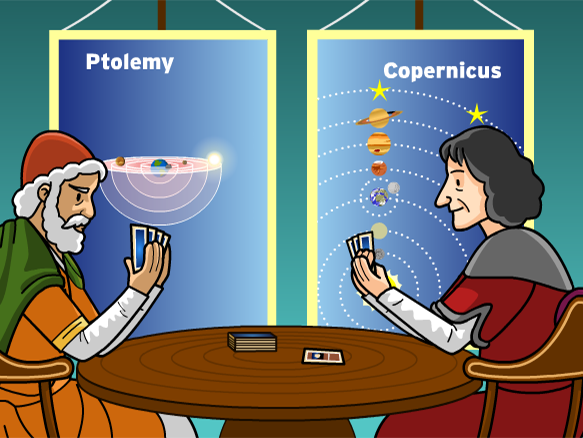
In fact, the confrontation between Galileo and the Church was not about science versus religion at all. It was about the two competing scientific cosmologies of the day:
Claudius Ptolemy’s earth-centered (geocentric) cosmology
versus
Nicolaus Copernicus’s sun-centered (heliocentric) cosmology
It was also about human ego, academic stubbornness, and the danger of blind consensus.
To understand how the drama unfolded you need to understand just four basic facts.