
Where Is Heaven, Exactly?
"Our Father, who art in heaven ..."

Glorious Day My Precious Fellow Traveler -
Writing these posts requires a great deal of time and toil because God demands and deserves my best effort. But I enjoy writing them.
My prayer for 2026 is that I’ll be able to stop doing other, less fulfilling things and instead support this page fulltime. That’ll be possible only with the support of Paid Subscribers. But I’m surrendering the entire matter to God.
From the bottom of my heart, thank you to my Paid Subscribers from 48 states and 35 nations for supporting my ministry, which is committed to speaking truth with love … to a world sorely in need of both.
To God alone be the glory!
Amen.
P. S. As a Christmas gift to my Paid Subscribers, at the end of this post you’ll be the very first to see the preliminary poster for my upcoming movie “THE INVISIBLE EVERYWHERE: Believing Is Seeing.” I hope you like it!
Defining Heaven
When our son was four years old he asked my wife and me: “Can you drive to heaven?” Out of the mouth of babes, right?
It’s a question only a child would ask, but it raises a very adult question: Where exactly is the heaven described in the Bible?

As a scientist I’m keenly aware of the importance of definitions. So, what precisely do we mean by “heaven?” Scripture describes a hierarchy of three very different heavens.
The first and lowest of these heavens is what we call Earth’s atmosphere.
“But the land that you are going over to possess is a land of hills and valleys, which drinks water by the rain from heaven.” Deuteronomy 11:11 (ESV)
The second, mid-level heaven is what we call outer space.
“When I look at your heavens, the work of your fingers, the moon and the stars, which you have set in place.” Psalm 8:3 (ESV)
The third, highest-level heaven is what we’re now talking about: It’s where God dwells.
“The Lord looks down from heaven; he sees all the children of man; from where he sits enthroned he looks out on all the inhabitants of the earth.” Psalm 33:13-14 (ESV)
Locating Heaven
As for heaven’s location, the Bible gives us some clues. For starters, the foregoing verse (Psalm 33:13-14) and other verses invariably describe us as looking “up” at God in heaven, and God as looking “down” at us on Earth.
But, again, definitions matter. What exactly does the Bible mean by “up” and “down”?
Imagine boarding a nuclear-powered rocket and traveling straight “up” into deep space. Will you ever reach a point far enough “up” into space that you finally reach heaven?
Before you laugh off the idea, consider this.
There was time when scientists thought our galaxy - the Milky Way - was the entire universe. By the 1920s, however, astronomers using powerful telescopes had discovered that - lo! - there are many other galaxies beyond our own. They called them “island universes.”
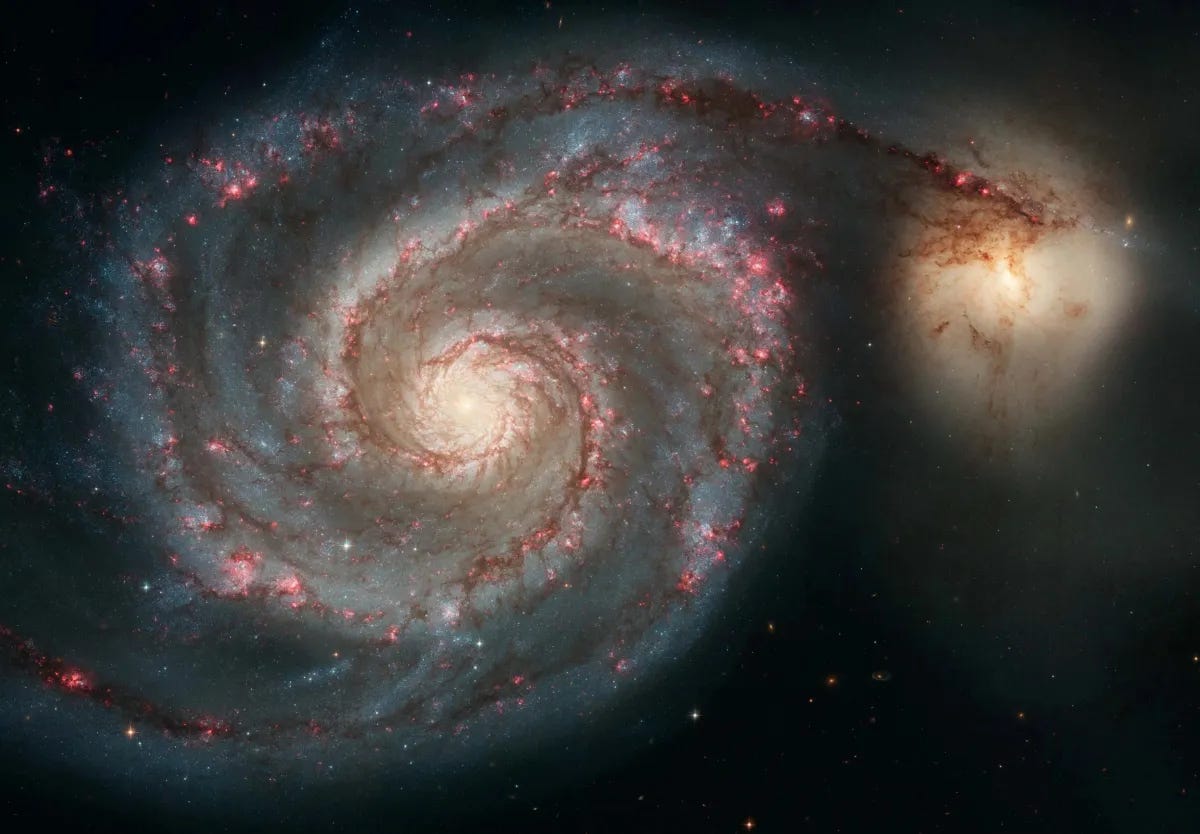
The significance of that discovery was greatly amplified when in 1929 American attorney-turned amateur astronomer Edwin Hubble discovered that these countless island universes - these countless galaxies - were rushing away from one another like so much shrapnel from a bomb. The simplest, most straightforward interpretation of this astonishing reality is that the universe exploded into being, meaning it had a definite beginning.
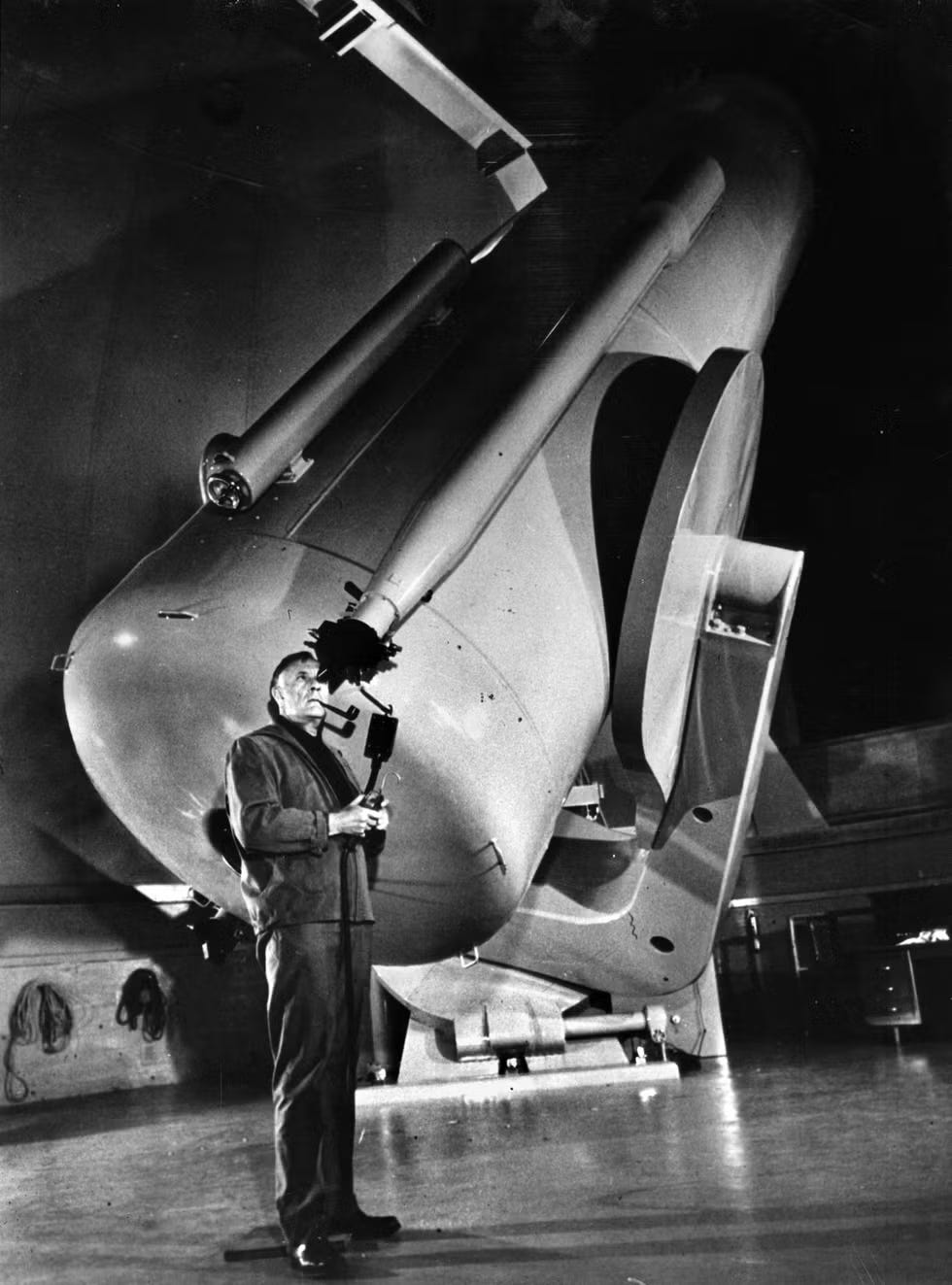
This was bombshell news because scientists always believed that the universe we see today has always existed. That over time it remains eternally the same, with no beginning and no end.
There was something else that Hubble discovered. There’s a definite pattern to how galaxies are rushing away from each other, namely: The farther “up” in space a galaxy is located - the farther away it is from Earth - the faster it’s moving away from Earth (and everything else).
It’s called Hubble’s Law, and mathematically it’s written like this:
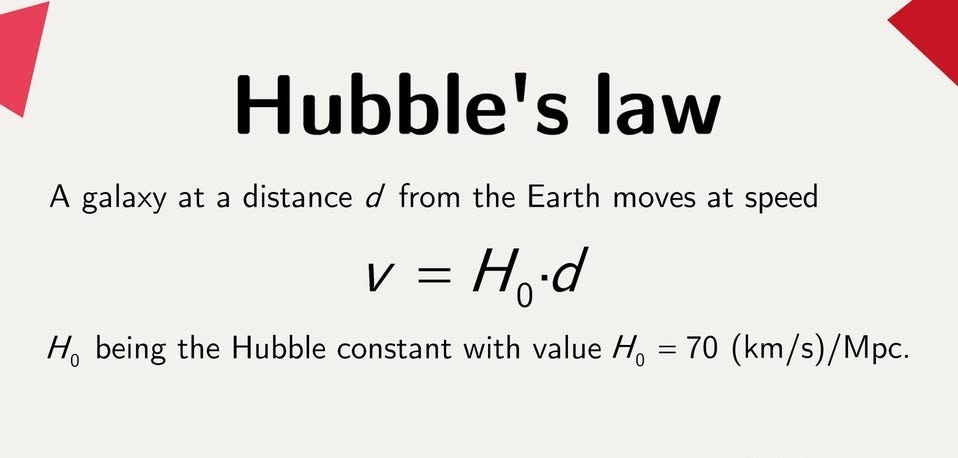
In plain English, if Galaxy A is twice as far from Earth as Galaxy B, then it’ll be moving away from Earth twice as fast. If Galaxy A is ten times as far from Earth as Galaxy B, then it’ll be moving away from Earth ten times as fast. And so forth.
But here’s where it gets really interesting.