
Why Modern Cosmology Sucks
In the beginning ....

Glorious Day My Precious Fellow Traveler -
I want to remind you that starting next year (Lord willing and the creek don’t rise), I’ll be publishing a new post every Wednesday. If there’s a topic you’d like me to discuss, drop me a line at info@sciencewithdrg.com.
All my beloved subscribers will get to see the first part of every post; paid subscribers will be able to see the full post.
Writing these posts takes a great of time and effort - God demands and deserves nothing but the best of everything - but I love doing them. My prayer for 2026 is that I can stop doing other, less fulfilling things and spend fulltime supporting this Substack ministry.
I’ll only be able to do that with the support of paid subscribers. However, I’m placing the matter in God’s hands.
To him alone be the glory! Amen.
Why Modern Cosmology Sucks
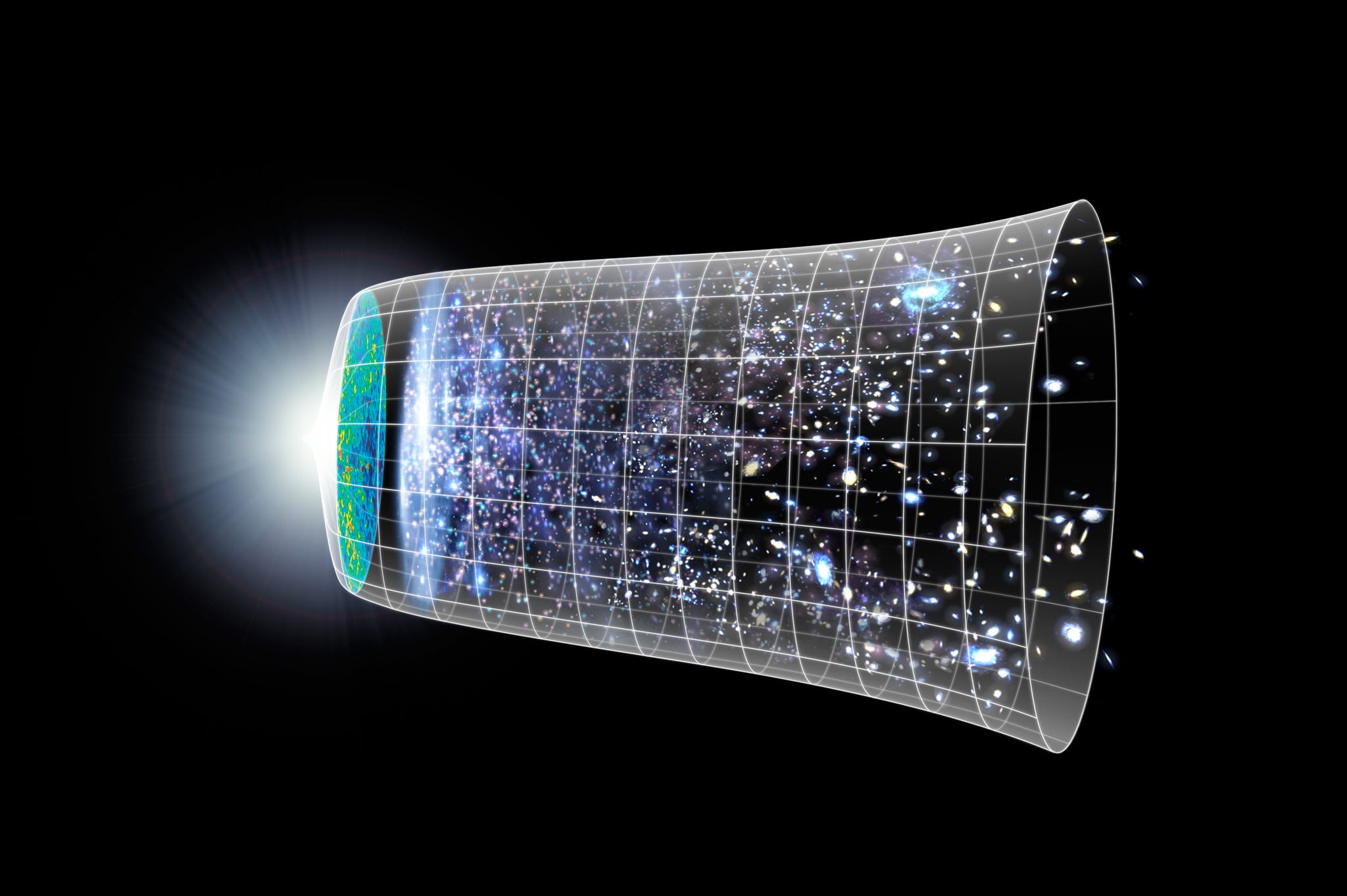
When I graduated from UCLA, I was thrilled to matriculate to Cornell for one main reason. I wanted to be an experimental high-energy physicist (the modern name for nuclear physicist), and Cornell was one of the very few universities in the world with its very own atom smasher: the brand-new, $11 million Robert Wilson Synchrotron.
After my first year there, however, I experienced a crisis of interest. I discovered that everything involved with exploring atoms - the tiniest things in the universe - had become super-sized. Being a high-energy experimental physicist now required getting huge amounts of funding (mostly from the National Science Foundation, Department of Energy, and U.S. military-industrial complex), building huge atom smashers and subatomic particle detectors, and being part of huge teams, which meant I could look forward to being a very small cog in a very large wheel.
That wasn’t for me.
Very quickly I set my sights on becoming a theoretical physicist, a solo artist who’s able to be alone with his thoughts. Who’s free to sit at a desk or to roam about the campus with his head in the clouds, conceiving of explanations for why the universe is the way it is.
It wasn’t an easy mid-course correction to make, but after satisfying certain formidable requirements - including taking two very rigorous courses on Einstein’s general theory of relativity - I was officially given permission to become a theoretical physicist. It was one of the happiest days of my young life!
In the Beginning
I can’t go into the details of everything that happened next, but over the course of some months, I decided to apply my theoretical musings not to the smallest things in the universe, but to the biggest ones: galaxies.

This sudden change of interest happened in part because a well-known Princeton astronomer, P.J.E. Peebles, found that, contrary to age-old scientific dogma, galaxies are not randomly distributed in space. Instead, they’re woven into a striking, tapestry-like pattern. It was a monumental revelation that demanded a theoretical explanation.
Immediately, I set about to find it. Remember, I was an Atheist at the time, so I wasn’t about to throw up my hands and praise Jesus. And because I’d never read the Bible, I was completely unaware of what Scripture had to say about Peebles’ discovery.
“The heavens proclaim the glory of God. The skies display his craftsmanship.”
Psalm 19:1
It took me years to propose a scientific explanation for the universe’s tapestry-like pattern because it proved to be a very complex challenge. In the end, however, my secular explanation earned me a similarly complex, multidisciplinary PhD degree in physics, math, and astronomy.
Quantum Vacuum
During those arduous years, I kept up with the thoughts of my fellow cosmologists - scientists who, like me, undertake to explain the origin of the cosmos, which includes but is not limited to its striking, tapestry-like pattern. In particular, I watched as they grappled with the famous big bang theory, which by then was plagued by many problems.